What 366,000 Google AI Search Impressions Reveal About SEO
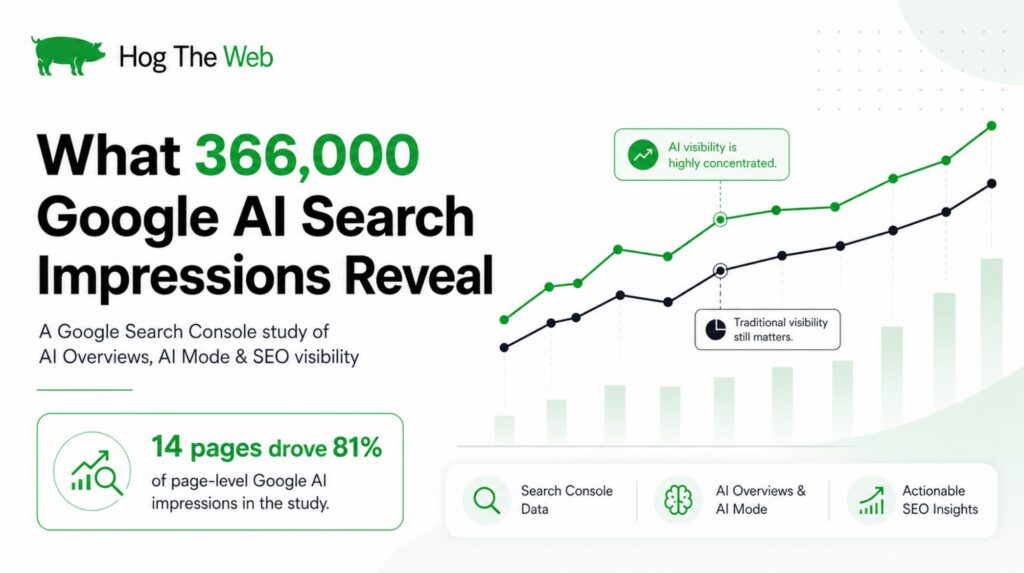
We analyzed nearly 366,000 first-party Google Search Console impressions from AI Overviews and AI Mode to see how generative AI visibility is distributed across a large content website, how it overlaps with traditional Search performance, and where the data raises new questions for SEO and AEO.
For the past couple of years, marketers have been told that AI search requires an entirely new playbook.
AEO. GEO. LLM optimization. AI citations. Prompt optimization.
Some of those ideas are useful. Others are mostly familiar SEO concepts with new labels attached.
Until recently, there was another problem: website owners had very little first-party data from Google showing where their pages were actually appearing inside Google’s generative search experiences.
That changed in 2026 when Google began rolling out its dedicated Generative AI Performance report in Search Console. The report measures impressions when links from a website appear in AI Overviews and AI Mode. Google documents the report here.
At Hog the Web, we had access to one of the properties receiving this new data.
So we dug in.
The dataset comes from a large, established health-information website. We compared its Generative AI Performance report against its standard Google Search Performance report over the exact same 99-day period, May 18 through August 24, 2026.
The generative AI report recorded 365,994 property-level impressions and 427,271 page-attributed impressions.
What we found was more interesting than a simple “SEO works for AI” story.
Google AI visibility was already substantial for this publisher, but it was also extremely uneven. A small minority of pages captured most AI exposure, and pages with remarkably similar traditional Search performance sometimes received several times more generative AI impressions than one another.
Traditional Search visibility and AI visibility were strongly related too, but there is an important statistical catch: Google’s AI impressions are already included inside its normal Web Search performance data. That means the two measures are not independent, and a high correlation between them should not be presented as proof that traditional SEO “causes” AI visibility.
That limitation actually makes the more granular differences between pages more interesting.
Study at a Glance
| Metric | Result |
|---|---|
| Study period | May 18-August 24, 2026 |
| Days analyzed | 99 |
| Property-level Google Search impressions | 1,505,180 |
| Property-level Google Search clicks | 64,820 |
| Property-level Search CTR | 4.31% |
| Property-level Generative AI impressions | 365,994 |
| Page-attributed Google Search impressions | 2,181,402 |
| Page-attributed Generative AI impressions | 427,271 |
| Unique normalized URLs in standard Search export | 155 |
| URLs with reported Generative AI impressions | 136 |
| URLs with no reported Generative AI impressions | 19 |
| Pages responsible for roughly 81% of page-level AI impressions | 14 |
| Median AI/Search impression ratio among pages with 1,000+ Search impressions | 23.3% |
Important: Generative AI impressions are included within Google’s broader Web Search performance data. The percentages used in this study are descriptive ratios, not mutually exclusive channel shares.
Methodology
We compared two first-party Google Search Console exports from the same website over the same May 18-August 24, 2026 period:
- The standard Google Search Performance report with clicks, impressions, CTR and average position.
- The dedicated Generative AI Performance report with impressions from AI Overviews and AI Mode.
Google currently combines AI Overviews and AI Mode within this report rather than allowing the two experiences to be separated. See Google’s Generative AI Performance report documentation.
Property-Level vs. Page-Level Data
One detail is particularly important when working with Search Console exports.
The property’s standard Search chart recorded 1,505,180 impressions, while summing its page-level Search table produced 2,181,402 impressions.
The same thing happened in the AI report:
- 365,994 property-level AI impressions
- 427,271 page-attributed AI impressions
This is expected behavior.
Google explains that property-level data can count multiple URLs from the same website as a single property impression, while data grouped by page can credit each qualifying URL separately. Google explains the AI report’s aggregation rules here.
For this reason, all site-level comparisons in this study use property against property, while URL-level comparisons use page against page.
URL Normalization
Before comparing URLs, we consolidated obvious variants that represented the same underlying page, including:
- Trailing-slash and non-trailing-slash versions
- URLs containing query parameters that resolved to the same underlying page
This left 155 normalized URLs in the standard Search dataset and 136 URLs with reported AI impressions.
Low-Volume Export Values
Google notes that values displayed as ~ or - inside Search Console are exported as zero. That means a zero in an export should sometimes be interpreted as “no reportable value in the exported data” rather than proof that an event literally never occurred. Google documents that behavior here.
Known Reporting Issue
Google also reported a logging error affecting the Generative AI Search report from August 13 through August 17, 2026. The issue reduced reported AI impressions but affected reporting only, not actual Google Search behavior. See Google’s Search Console Data Anomalies page.
Because page-level exports cannot retrospectively remove those five dates without a separately filtered export, the full-period page analysis still contains that underreporting. Actual AI impressions during the study period were therefore likely somewhat higher than the exported totals.
Finding #1: Generative AI Visibility Was Already Material for This Publisher
During the 99-day study period, the site recorded:
- 1,505,180 property-level Google Search impressions
- 365,994 property-level Generative AI impressions
Generative AI impressions were therefore equivalent to approximately:
24.3% of the property’s total Search impression count.
That figure needs to be interpreted carefully.
It does not mean 24.3% of Google searches contained an AI Overview. It does not mean AI generated 24.3% of the site’s traffic either.
And the two numbers should not be added together.
Google explicitly says that data shown in the dedicated Generative AI report is also included within the site’s normal Search Performance data. Google confirmed this when announcing the report.
So 24.3% is best understood as a visibility ratio:
For every 100 property-level Search impressions reported during this period, the property recorded roughly 24 impressions within Google’s supported generative AI experiences.
For an established publisher, that is large enough that AI visibility is no longer something we would treat as an experimental footnote in an SEO report.
Finding #2: A Small Number of Pages Captured Most Google AI Visibility
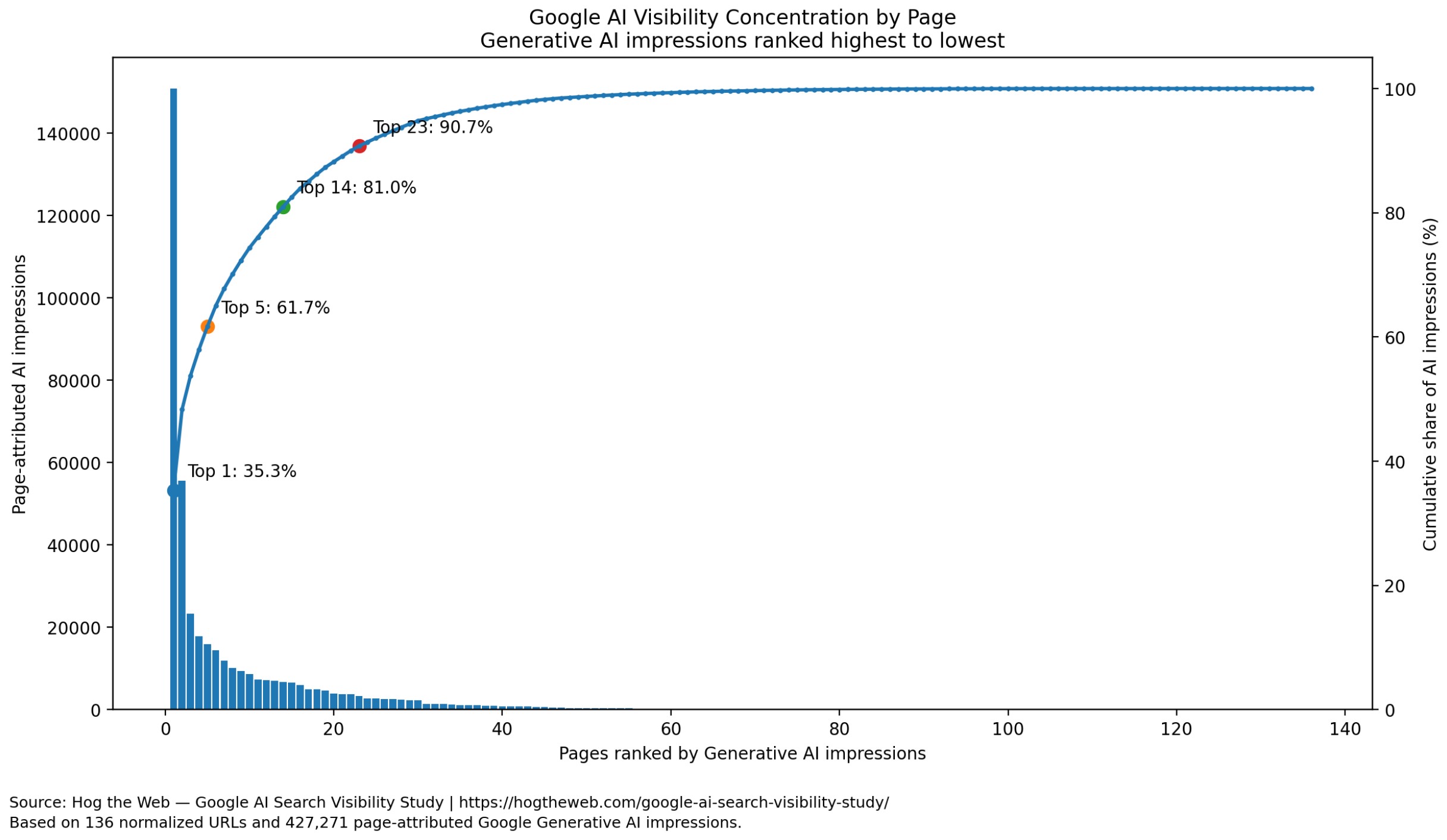
The clearest finding in the dataset was concentration.
After consolidating URL variants, the site had 136 pages with reported Generative AI impressions.
But those impressions were nowhere close to evenly distributed.
| Top Pages | Share of Page-Attributed AI Impressions |
|---|---|
| Top 1 page | 35.3% |
| Top 5 pages | 61.7% |
| Top 10 pages | 74.4% |
| Top 14 pages | 81.0% |
| Top 23 pages | 90.7% |
In other words:
About 10% of the AI-visible pages accounted for 81% of the site’s page-attributed Google AI impressions.
The homepage was unusually dominant and generated about 35.3% of page-level AI impressions by itself.
So we repeated the calculation without it.
The concentration was still substantial:
18 of the remaining 135 pages, or 13.3%, generated approximately 80.4% of all non-homepage AI impressions.
This concentration is not necessarily unique to AI. Traditional organic visibility is often highly concentrated too, especially on large content websites.
But it does raise a useful strategic point.
If most AI exposure is being generated by a relatively small set of proven pages, attempting to “AI optimize” every URL on a website equally may not be the highest-value use of time.
Finding #3: Nearly Every Page With Meaningful Traditional Search Exposure Also Appeared in the AI Report
There were 155 normalized URLs in the site’s standard Search page export.
Of those:
- 136 recorded reported Generative AI impressions
- 19 had no reported Generative AI impressions in the export
The negative cases were interesting because they were overwhelmingly tiny Search pages.
The Search URL with the most traditional visibility but no reported AI impressions had just 366 Search impressions during the entire 99-day period.
The others generally consisted of very low-volume archive, pagination, testimonial and similar URLs.
Most had fewer than 100 conventional Search impressions.
In fact:
Every URL in this dataset with at least 1,000 traditional Search impressions also recorded Generative AI impressions.
There were 59 such URLs.
This is a single-site observation, and Google’s treatment of very low-volume values means we should not interpret the 19 exported zeros too literally.
Still, there was no example in this dataset of a page earning substantial conventional Google exposure while being completely absent from the AI report.
That is consistent with Google’s explanation that its generative AI features are rooted in its existing Search systems.
Google says its AI features use techniques including retrieval-augmented generation, where its core Search ranking systems retrieve relevant pages from the Search index, as well as query fan-out, where the system can issue multiple related searches to gather information for a broader answer. Google describes those systems here.
Finding #4: Bigger Search Pages Usually Had More AI Exposure, But the Correlation Needs Context
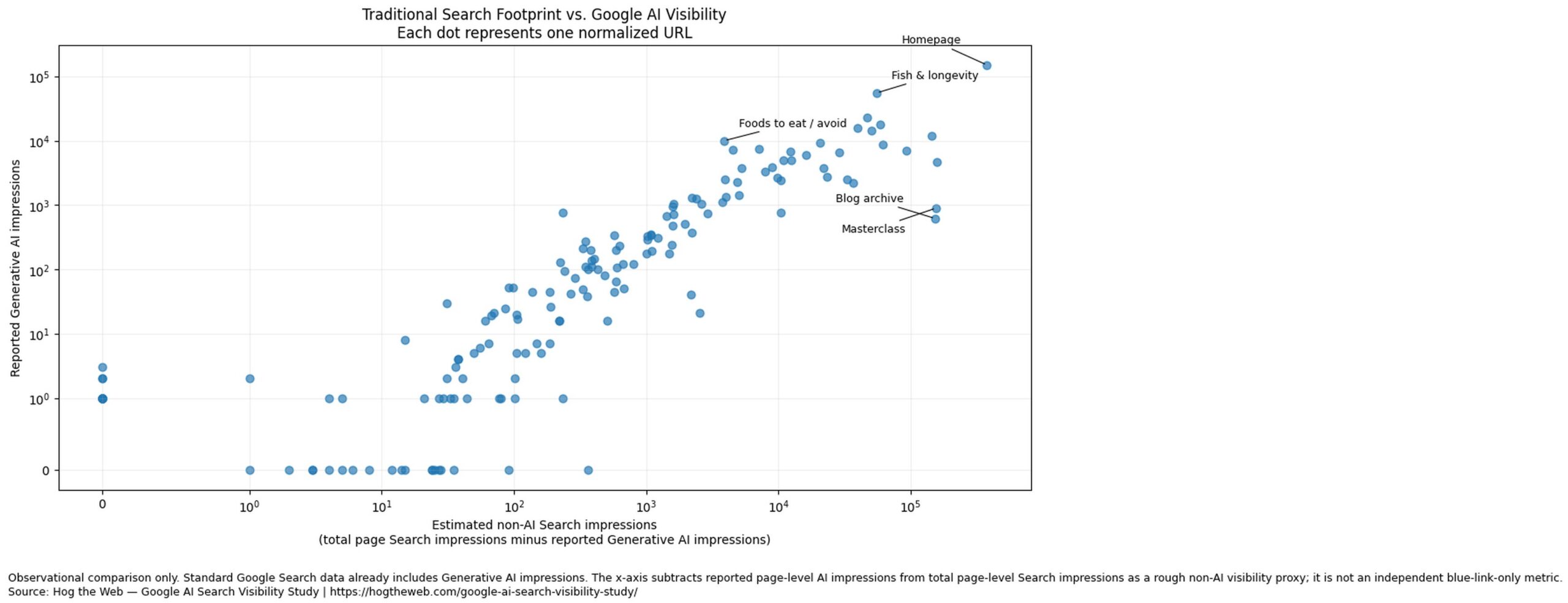
When we rank-correlated all 155 traditional Search URLs, including the 19 pages with no reported AI impressions, Search impressions and AI impressions had a Spearman correlation of:
ρ = 0.942
Among only the 136 AI-visible pages, the figure rose to approximately:
ρ = 0.952
At first glance, that looks like an exceptionally strong result.
But there is a major caveat.
Generative AI impressions are already a subset of the broader Web Search impressions.
So these are not two independent systems being compared.
Some amount of positive relationship is mathematically expected: a page with vastly more total Search exposure has more opportunities to accumulate impressions inside the subset of Search experiences that contain Google’s generative AI features.
For that reason, we do not interpret the 0.94 correlation as proof that traditional SEO performance causes AI visibility.
As a rough sensitivity check, we also subtracted each page’s reported AI impressions from its total page-level Search impressions to estimate a non-AI Search impression proxy.
Among AI-visible pages, the correlation between that remaining Search exposure and AI impressions was still approximately:
ρ = 0.933
That’s interesting, but it is still not a clean experimental comparison. Search Console does not currently give us a truly independent “traditional blue-link-only impressions” metric that can be perfectly matched against the Generative AI report.
Our more conservative conclusion is simply:
Pages with large traditional organic footprints tended to also be large AI-visibility pages on this website.
That’s useful context. It isn’t the headline discovery.
Finding #5: AI Exposure Varied Dramatically Even Among Pages With Meaningful Search Visibility
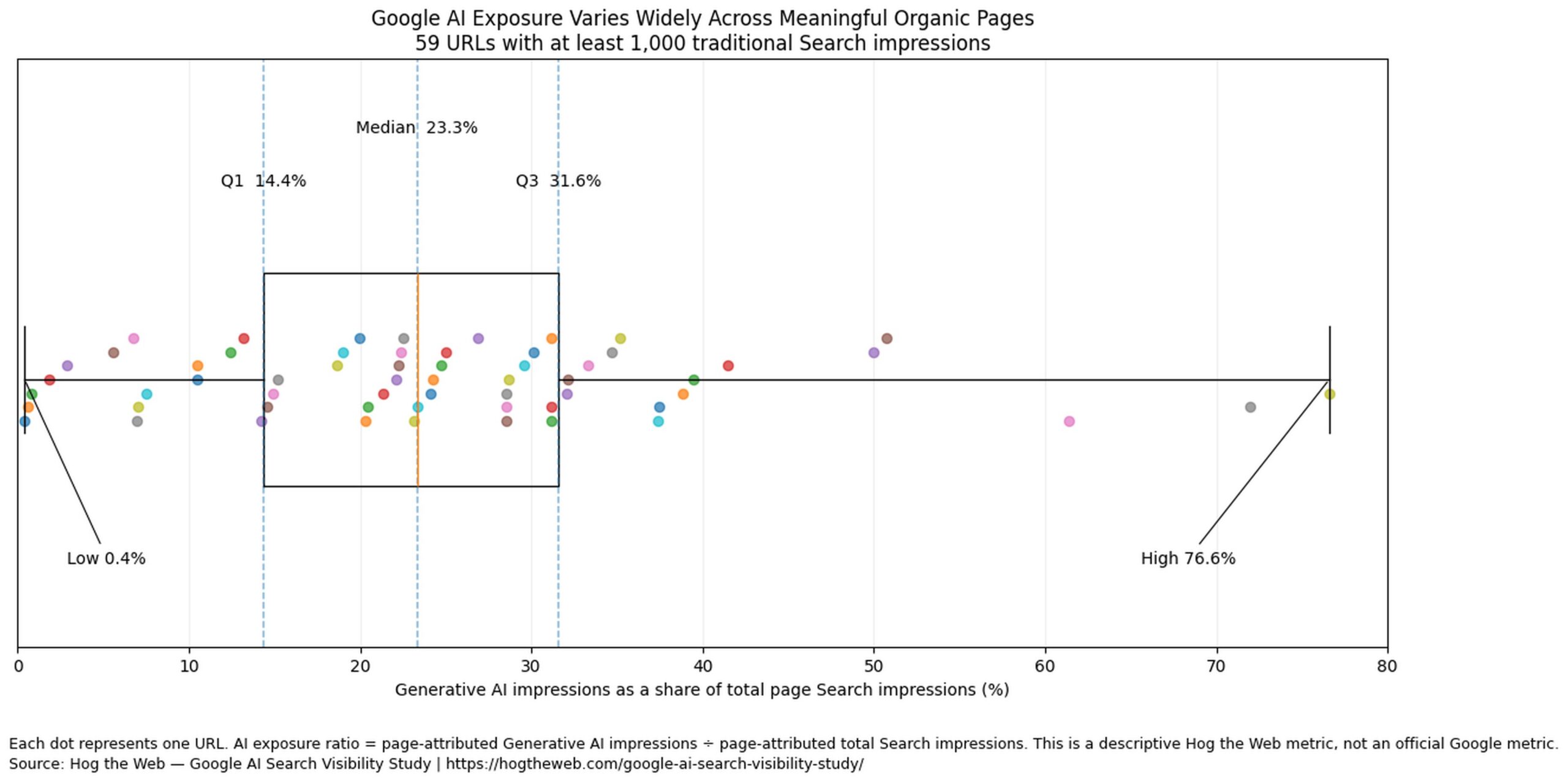
To look beyond raw page size, we calculated a simple descriptive metric:
AI impression ratio = page-attributed Generative AI impressions ÷ page-attributed total Search impressions
This is not an official Google metric.
It is also not a percentage of searches that triggered AI, because we do not have the underlying query-level AI data.
It simply lets us compare how much reported AI exposure different URLs accumulated relative to their overall page-level Search exposure.
Among the 59 pages with at least 1,000 traditional Search impressions:
| AI Impression Ratio | Result |
|---|---|
| 25th percentile | 14.4% |
| Median | 23.3% |
| 75th percentile | 31.6% |
| Lowest observed ratio | 0.4% |
| Highest observed ratio | 76.6% |
So even after excluding tiny pages, the relative amount of AI exposure varied enormously.
A quarter of these pages had AI impression ratios below roughly 14%, while another quarter exceeded roughly 32%.
Some were much farther outside that range.
This variation is where the dataset becomes much more useful than the raw correlation.
Finding #6: Nearly Identical Search Exposure Could Still Produce Very Different AI Exposure
Several page comparisons illustrate the problem especially well.
Example #1: Almost Identical Search Impressions, 2.7X Difference in AI Visibility
| Metric | Liver-Health Article | Dark Chocolate / Heavy Metals Article |
|---|---|---|
| Search impressions | 69,872 | 70,000 |
| Average position | 6.83 | 7.49 |
| AI impressions | 23,275 | 8,696 |
| AI impression ratio | 33.3% | 12.4% |
Their traditional Search impression totals differed by less than 0.2%.
Yet one accumulated approximately 2.7 times more Generative AI impressions.
Example #2: Similar Search Footprints, 4.4X Difference
| Metric | Food Dosage Article | Processed-Food Article |
|---|---|---|
| Search impressions | 11,339 | 11,192 |
| Average position | 8.39 | 9.97 |
| AI impressions | 3,354 | 756 |
| AI impression ratio | 29.6% | 6.8% |
The pages had only about a 1.3% difference in traditional Search impressions, yet the first received approximately 4.4 times more AI impressions.
Example #3: Similar Position and Search Exposure, Nearly 5X Difference
| Metric | Diet Book Page | Masterclass Page |
|---|---|---|
| Search impressions | 162,575 | 156,144 |
| Average position | 3.96 | 3.92 |
| AI impressions | 4,624 | 895 |
| AI impression ratio | 2.8% | 0.6% |
The traditional visibility of these two pages looks remarkably similar on the surface.
Their Generative AI exposure does not.
Finding #7: The Most Obvious Explanation May Be Query Mix, Not an “AI-Optimized” Page
It would be tempting to look at the examples above and conclude that the pages receiving more AI impressions must have superior headings, better schema, more citations or some hidden AEO advantage.
We can’t make that conclusion from this dataset.
The much simpler explanation may be the queries each page ranks for.
Imagine two pages each generating 70,000 Google impressions.
One might rank primarily for questions where Google frequently displays an AI Overview.
The other might rank for searches that rarely generate a generative answer at all.
The pages could have identical SEO quality and still produce dramatically different AI impression counts.
Unfortunately, Google’s current Generative AI Performance report does not expose the underlying queries. Available dimensions include page, country, device and date, but not the search terms responsible for each AI impression. See Google’s current report documentation.
That makes query mix a major uncontrolled variable in this study.
So rather than calling a page an “AI underperformer,” a better workflow is:
- Identify pages with unusually high or low AI exposure relative to their overall Search footprint.
- Treat those pages as candidates for investigation, not evidence of an optimization problem.
- Analyze the traditional Search queries those pages rank for.
- Compare search intent, topic, SERP format and likely propensity to trigger AI features.
- Only then investigate differences in content structure, authority, expertise or technical implementation.
That’s less exciting than claiming we discovered five new AI ranking factors.
It’s also much more defensible.
Finding #8: Some High-Visibility Pages Had Surprisingly Low CTRs
While analyzing the page data, another pattern stood out.
Several pages had extremely low overall Search click-through rates despite substantial impressions and strong-looking average positions.
| Page / Topic | Search Impressions | Clicks | CTR | Avg. Position | AI Impressions | AI Impression Ratio |
|---|---|---|---|---|---|---|
| Fish & longevity | 111,244 | 171 | 0.15% | 2.97 | 55,579 | 50.0% |
| Avocados / healthy fats | 76,404 | 117 | 0.15% | 7.43 | 17,831 | 23.3% |
| Guava health benefits | 157,051 | 254 | 0.16% | 9.55 | 11,830 | 7.5% |
| Foods to eat / foods to avoid | 13,955 | 1,240 | 8.89% | 4.09 | 10,043 | 72.0% |
The first row is especially striking: more than 111,000 Search impressions, an average position of 2.97, but only a 0.15% CTR.
At first glance, that might look like evidence that AI Overviews are creating a zero-click effect.
But the rest of the table makes that explanation too simple.
The “foods to eat / foods to avoid” article had an even higher AI impression ratio of approximately 72% and still produced an 8.89% overall Search CTR.
Meanwhile, the guava article had an AI impression ratio of only 7.5% and still had a CTR around 0.16%.
So this dataset does not support a simple conclusion that more AI visibility automatically means fewer clicks.
There are likely substantial differences in:
- Query intent
- Search-result layout
- Brand versus non-brand searches
- Image and video results
- Knowledge features
- AI Overview prevalence
- The kinds of queries contributing to the page’s average position
Average position also needs special care in AI-enhanced results.
Google explains that an AI Overview occupies one Search position and every link inside that AI Overview receives the same position. AI Mode also contributes normal impression, click and position data to Search Console. Google explains how AI Overview and AI Mode metrics are counted here.
That means an average position of 2.97 should no longer automatically be interpreted as:
“This URL appeared as a conventional blue link in position three 111,000 times.”
This CTR pattern deserves a separate follow-up study with page-filtered query exports.
Finding #9: Mobile Accounted for a Larger Share of AI Exposure
Device distribution also differed between the two reports.
| Device | Generative AI Impression Share | Total Search Impression Share |
|---|---|---|
| Mobile | 72.4% | 63.0% |
| Desktop | 24.8% | 35.0% |
| Tablet | 2.8% | 2.0% |
Mobile represented roughly 9.4 percentage points more of the property’s AI visibility than of its overall Search visibility.
That does not mean Google inherently favors mobile pages in AI results.
The difference could instead reflect user behavior, query mix, countries, device-specific AI feature availability or other factors.
Still, for this website, generative AI visibility was decidedly mobile-heavy.
Google’s own generative AI guidance continues to recommend standard page-experience fundamentals, including making sites work well across devices. See Google’s generative AI optimization guide.
Finding #10: AI Visibility Was International, but the Mix Wasn’t Identical to Traditional Search
| Country | AI Impressions | AI Impression Share | Total Search Impression Share |
|---|---|---|---|
| United States | 196,826 | 53.8% | 51.6% |
| India | 38,594 | 10.5% | 6.7% |
| United Kingdom | 26,731 | 7.3% | 6.5% |
| Canada | 22,967 | 6.3% | 7.1% |
| Australia | 19,594 | 5.4% | 4.5% |
Those five countries generated approximately 83.3% of the site’s reported Generative AI impressions.
India was the most obvious difference between the two reports, generating about 10.5% of AI impressions but only 6.7% of overall Search impressions.
A single website cannot tell us why.
Possible explanations include differences in query behavior, device use, topic demand, Google’s AI-feature availability and country-specific adoption.
It’s something worth monitoring across additional websites as Search Console makes the report more widely available.
So What Does This Study Actually Tell Us About SEO and AEO?
There are two conclusions we feel comfortable making.
1. AI Search Does Not Appear to Be a Completely Separate Search Ecosystem
Meaningful organic pages on this property overwhelmingly also appeared in Google’s generative AI reporting.
Every URL with at least 1,000 Search impressions had some reported AI visibility.
And larger traditional Search pages generally accumulated more AI impressions as well.
That is consistent with Google’s own description of how its generative search systems work.
Google now says explicitly that SEO best practices continue to matter because AI Overviews and AI Mode are rooted in its core Search ranking and quality systems. Google also says that from its perspective, optimizing for generative AI Search is still fundamentally SEO. Read Google’s guidance.
2. Traditional Search Metrics Still Don’t Tell the Whole AI Story
Pages with remarkably similar:
- Search impressions
- Average positions
- Website authority
- Publishing environment
could still receive several times different levels of Generative AI exposure.
We cannot yet tell how much of that difference comes from the page itself versus the searches that page happens to rank for.
That’s the important unanswered question.
And it’s where we think legitimate AEO analysis begins.
SEO builds the foundation. AEO should help us measure and investigate how answer-driven search experiences use that foundation differently.
What Website Owners Should Do With This Data
1. Keep Investing in the SEO Fundamentals
Google’s own AI documentation says its generative features depend on the Search index and core Search ranking systems.
Crawlability, indexability, technical health, useful content, internal links, authority and good page experience have not suddenly become obsolete. Google’s AI optimization guidance reinforces that point.
2. Start Measuring AI Visibility Separately
If your Search Console property has access to the Generative AI report, use it.
Traditional rankings and traffic alone won’t show which pages are gaining substantial exposure through AI Overviews and AI Mode. Consider AI traffic and visibility tracking as well.
3. Identify AI Outliers, but Don’t Immediately “Fix” Them
Pages with unusually high or low AI impression ratios are useful research candidates.
They are not automatically proof that one page is better optimized than another.
Investigate query mix and search intent before changing content that may already be performing well.
4. Study Your Existing Winners Before Mass-Producing New AI Content
Just 14 pages generated approximately 81% of AI impressions in this dataset.
There may be more to learn from improving and understanding a small number of proven assets than from publishing hundreds of pages targeting slightly different prompts.
Google specifically warns against creating large quantities of pages for every possible query or fan-out variation primarily to manipulate Search or generative AI responses. See Google’s guidance on non-commodity content and scaled content.
5. Focus on Information That Adds Something New
Google’s 2026 AI Search guidance puts unusually strong emphasis on what it calls unique, valuable and non-commodity content.
That can include:
- First-hand experience
- Original research and data
- Expert analysis
- Real case studies
- Unique professional insights
- Useful images and video
- Specific information that isn’t simply repeated from other websites
That’s a considerably more sustainable strategy than trying to reverse-engineer a special sentence structure for AI. Google discusses non-commodity content here.
6. Don’t Chase Unsupported Google AI “Hacks”
Google now specifically says websites do not need special AI-only tactics such as:
llms.txtfor Google Search- Special AI markup
- Artificially chunking content into tiny sections
- Rewriting pages specifically for AI systems
- Creating every imaginable long-tail prompt variation
- Special schema.org markup for AI Search
- Inauthentic brand mentions
Structured data can still be useful for normal Search features, but Google says there is no special schema required for AI Overviews or AI Mode. Google’s mythbusting section covers these claims directly.
7. Watch CTR Alongside AI Visibility
Some of the most interesting numbers in this dataset weren’t AI impression totals at all.
They were pages earning enormous Search exposure and strong average positions while producing surprisingly few clicks.
We don’t yet know why.
But as AI-enhanced results become a larger part of Google’s interface, SEO reporting should increasingly look at:
- Visibility
- Click-through rate
- Result type
- Query intent
- Conversions
rather than assuming ranking position tells the whole story.
Important Limitations
This is an observational case study of one website, not a universal study of Google’s AI ranking factors.
One Website
The source property is a large, established health-information website.
Results could differ significantly for ecommerce stores, SaaS companies, local businesses, B2B services, travel sites, publishers and other industries.
Health Is a YMYL Topic
Health information sits within a category where expertise, reliability and trust can be especially important.
Patterns on this property may not generalize to less sensitive subjects.
No Generative AI Query Data
This is one of the study’s biggest limitations.
Google’s Generative AI Performance report currently does not provide the queries behind AI impressions.
Without that dimension, we cannot separate page-level effects from differences in the types of searches each page ranks for. See the currently available dimensions.
AI Overviews and AI Mode Are Combined
The report includes both experiences in one dataset.
We cannot determine how many impressions came from AI Overviews versus AI Mode.
AI Data Is Already Included in Standard Search Data
This is why the raw Search-vs-AI correlation should not be treated as independent evidence that SEO causes AI visibility.
Google confirms that the dedicated Generative AI report is a separate view of data that also contributes to the site’s overall Search Performance report. Google’s announcement explains this directly.
The August 13-17 Logging Error
Google underreported Generative AI impressions during these five days because of a logging issue. The problem affected reporting only. Google’s data anomaly documentation.
The Newest Data Can Be Preliminary
Google notes that its newest Generative AI data can still be preliminary and may change while processing finishes. The export used in this study was generated shortly after the end of the reporting window. See Google’s note on preliminary data.
Exported Zeros Are Not Always Literal Zeros
Google says values shown as ~ or - in the interface become zero when exported.
This matters particularly when interpreting very low-volume pages.
Impressions Are Not Traffic or Recommendations
An AI impression means a link from the website was shown within a supported Google generative feature.
It does not necessarily mean:
- The user clicked the link
- The site was explicitly recommended by Google’s AI
- The website was quoted in the answer
- The user visited the site
- A lead or sale occurred
This study is about AI search visibility, not AI traffic.
Correlation Does Not Establish Causation
Nothing in this dataset establishes that a particular heading, content structure, schema implementation or SEO metric causes higher Generative AI visibility.
The study identifies patterns and questions worth investigating with larger datasets.
Conclusion: AI Search Looks Less Like a Replacement for SEO and More Like a New Layer on Top of It
Google’s Generative AI Performance report gives website owners something we’ve been missing throughout much of the AI-search transition:
first-party visibility data.
And this first dataset paints a more nuanced picture than either extreme of the SEO debate.
We don’t see evidence here that traditional SEO has suddenly become irrelevant.
Quite the opposite.
Every page on this property with meaningful traditional Search exposure also registered Generative AI visibility, and larger organic pages generally accumulated more AI exposure as well.
That fits Google’s explanation that AI Overviews and AI Mode are built on top of its existing Search index, ranking systems and quality systems.
But conventional SEO metrics don’t explain everything either.
Two pages can generate almost exactly the same number of Search impressions and hold similar average positions while receiving two, four or even five times different amounts of Google AI exposure.
We can’t yet say whether those differences come primarily from:
- Query mix
- Search intent
- AI-feature prevalence
- Content characteristics
- Topical coverage
- Entity relationships
- Or some combination of those factors
That’s the next question worth studying.
For now, our takeaway at Hog the Web is fairly simple:
Don’t throw out SEO to chase AI search. Build strong web assets, measure where those assets appear in AI experiences, investigate the outliers, and improve based on evidence rather than the latest GEO trick.
AI has changed the Search interface.
It has also given SEOs some genuinely new things to measure.
That doesn’t mean the old fundamentals disappeared.
About the Data and Disclosure
This analysis uses first-party Google Search Console exports from an established third-party health-information website. The website is anonymized in this public report, and its private Search Console exports are not being publicly released.
All statistics presented in this study were calculated from the exported data described in the methodology above.
Hog the Web provides SEO and AI-search optimization services and therefore has a commercial interest in the broader subject of search visibility. We have included the study’s methodological limitations and avoided treating observed associations as confirmed Google ranking factors.
References
- Google Search Console: Generative AI Performance Report
Google’s documentation describing what the report includes, AI Overviews and AI Mode, available dimensions, aggregation, preliminary data and export behavior.
https://support.google.com/webmasters/answer/16984139 - Google Search Central: Optimizing Your Website for Generative AI Features on Google Search
Google’s guidance on traditional SEO, AEO/GEO, retrieval-augmented generation, query fan-out, non-commodity content, technical SEO, structured data, llms.txt and other AI-search claims.
https://developers.google.com/search/docs/fundamentals/ai-optimization-guide - Google Search Central: Introducing Search Generative AI Performance Reports in Search Console
Google’s announcement confirming that Generative AI data is also included within overall Search performance reporting.
https://developers.google.com/search/blog/2026/06/gen-ai-performance-reports - Google Search Console: What Are Impressions, Position and Clicks?
Google’s methodology for Search metrics, including specific rules for AI Mode and AI Overviews. Google notes that an AI Overview occupies one position and all links contained within it receive that position.
https://support.google.com/webmasters/answer/7042828 - Google Search Console: Data Anomalies
Google’s documentation of the August 13-17, 2026 Generative AI Search reporting error.
https://support.google.com/webmasters/answer/6211453

Levi is the Founder & CEO of Hog The Web, a web design and WordPress services company delivering high-performance websites since 2015. With over a decade of hands-on experience in building, maintaining, and securing websites, Levi leads his team with a focus on craftsmanship, reliability, and long-term client partnerships. Outside the web world, he’s passionate about nature, sustainable living, and giving back through local non-profits and youth education.