WE CAN HELP
SEO-Preserving
WordPress Redesign
Considering a new WordPress website, but concerned about the search rankings and organic traffic you already have? We handle SEO preservation as part of the redesign itself. Our WordPress design, development and technical SEO team maps valuable URLs, content and search signals before launch so the new site builds on what works.
Have an established website? See what we keep versus change, or review our real redesign results.



+49.9%
AMS homepage engagement rate, first 42 days
+46%
AMS homepage GSC impressions, same period
SEO + Design
Search preservation, UX and development
300+
Businesses served by Hog the Web
Better Design. Without Abandoning What Already Ranks.
Your existing WordPress website may already have valuable pages, backlinks and search visibility. We identify what is worth protecting before redesigning the experience, then handle the content, development and technical SEO work together. The goal is a more effective website without casually discarding years of progress.
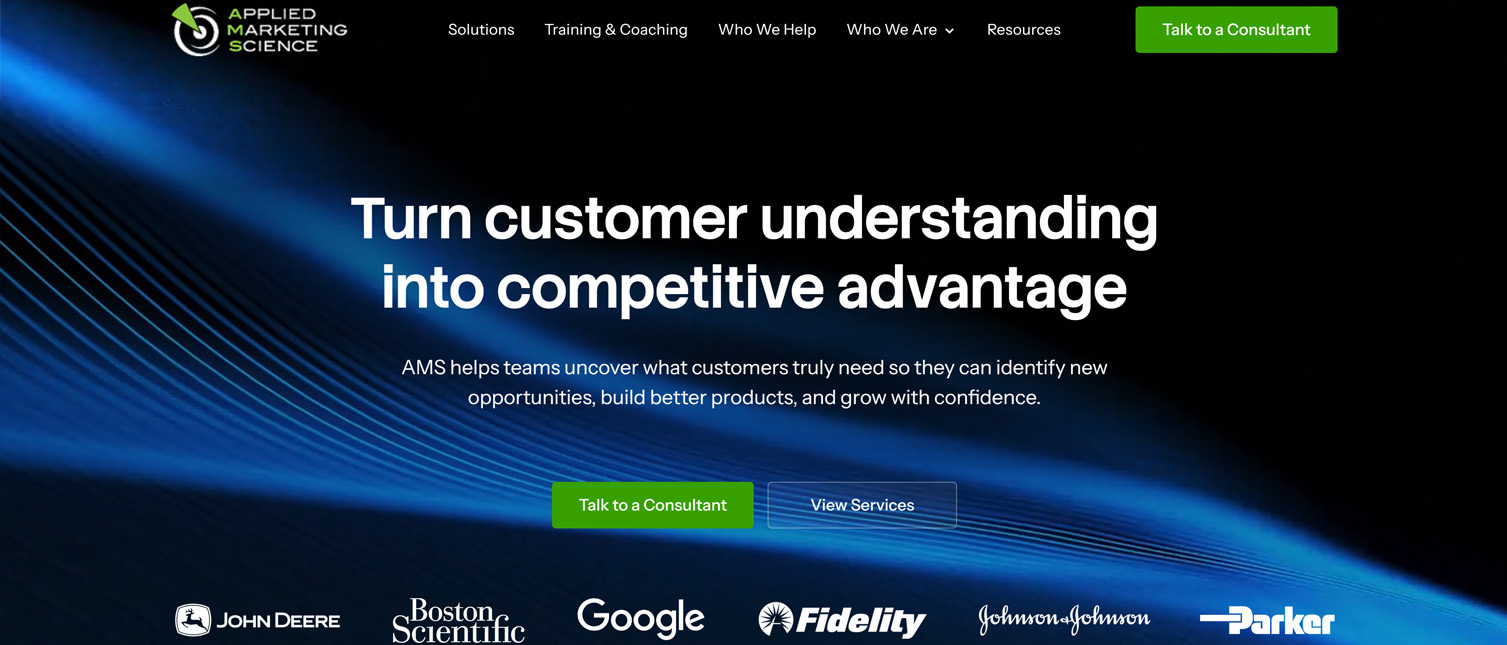
Our redesigned WordPress homepage for Applied Marketing Science. See the results below.
FIRSTHAND REDESIGN EVIDENCE
Applied Marketing Science: A Better Website, With Its Search Foundation Intact
AMS needed a clearer way to explain its complex consulting services, make valuable proof easier to find, and encourage deeper exploration. In July 2026, we launched a redesigned WordPress website with search visibility and visitor behavior both part of the plan. We measured its first 42 days against the preceding 42 days using GA4, Google Search Console and Microsoft Clarity. Read the complete AMS redesign case study.
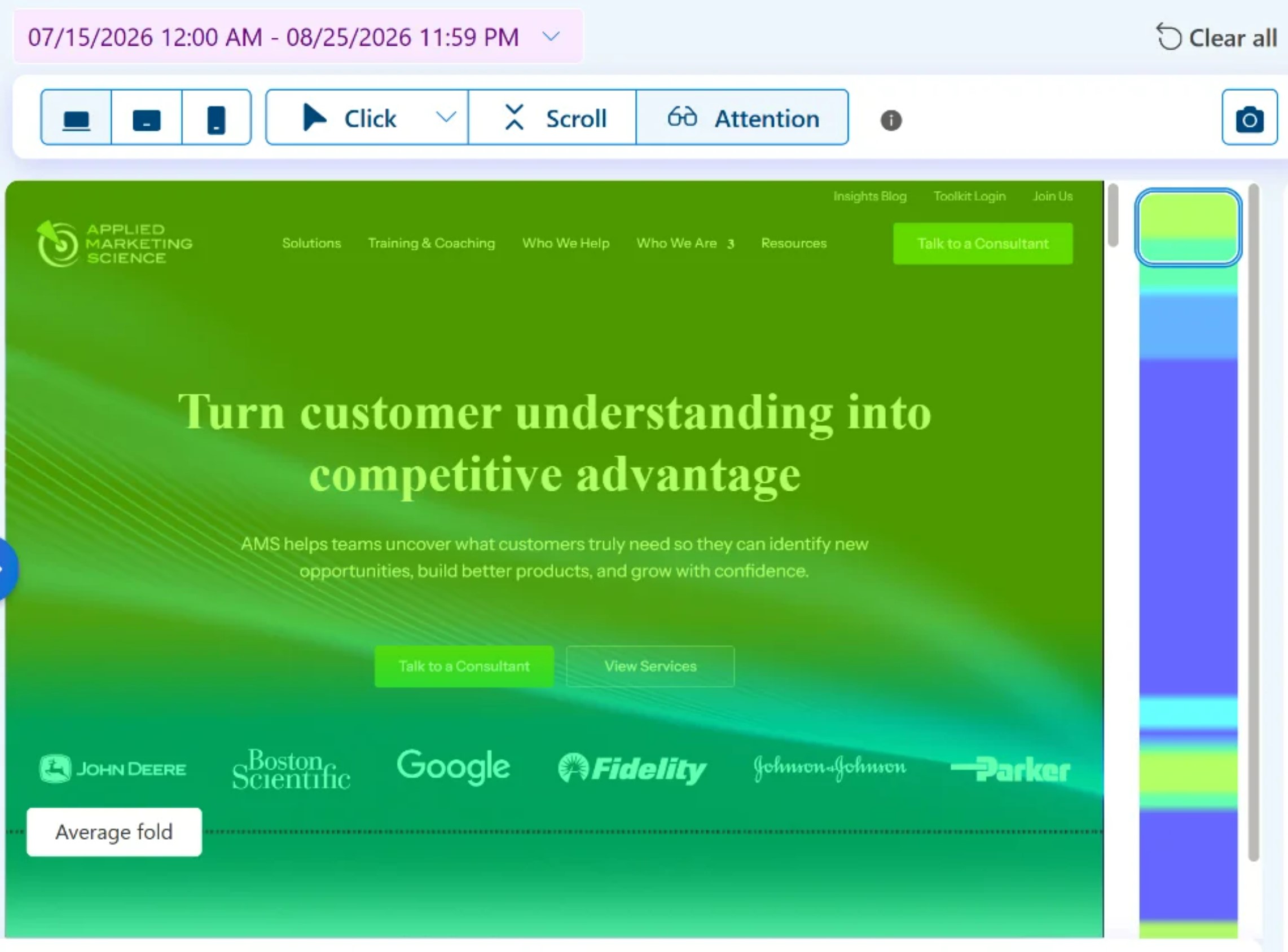
Microsoft Clarity attention-map view. An observed post-launch heat/attention view, not a search ranking chart.
The redesign goal
Make complex services easier to understand without treating established organic visibility as disposable.
- Clarify value proposition and navigation
- Keep meaningful content and discovery paths in the plan
- Give visitors obvious next steps
What HTW changed
We reframed the homepage as a useful decision hub with clearer service journeys, client proof and stronger content hierarchy.
- Improved service and audience pathways
- Surfaced testimonials, logos and case studies
- Tracked post-launch engagement and search performance
What the measurements showed
The early data showed stronger engagement and an expanded search footprint, not a guaranteed SEO outcome.
- Homepage engagement rate +49.9% relative
- Homepage GSC impressions +46%
- Engaged sessions +36.1%
What changed in the first 42 days?
Engagement and search visibility both improved in the initial 42-day comparison: homepage engagement rate rose 49.9%, engaged sessions rose 36.1%, and Google Search Console homepage impressions grew 46%. The number of search queries generating homepage impressions increased 253%.
That 253% refers to the number of queries with impressions, not a 253% increase in visits. These are early relative changes, not proof that every ranking was preserved or that engagement equals conversions. Read the full AMS case study.
“They’ve become a great asset to the Marketing Department here”
— Rachelyn P., client review on Hog the Web reviews
What a Bad Redesign Can Cost: Imhoff’s Firsthand Experience
Not every redesign preserves existing SEO. Imhoff’s earlier replacement removed valuable content and URLs, and the resulting traffic loss was severe. Doug shares his experience here.
HEAR IT DIRECTLY FROM THE CLIENT
What Happens When a Redesign Throws Away Your SEO?
“Look at what happened to my traffic when I went back to Hog the Web... Boom!”
Doug Imhoff, founder of Imhoff Fine Residential Painting. He describes the search visibility crisis following a replacement website and what changed after HTW rebuilt the site.
THE OTHER SIDE OF THE STORY
What Happens When a Redesign Forgets the Existing SEO?
Imhoff Painting's replacement site reduced a content-rich website to roughly five pages without preserving critical old URLs. Organic visits fell from more than 300 per day to fewer than 10. We later rebuilt valuable pages and URL paths, restored traffic to around 300 daily visits within about a month of relaunch, and improved tracked conversions by 75% versus the original site.
The screenshots below show the original website and our eventual WordPress rebuild, not the failed five-page replacement. The difference we emphasize is the decision to retain useful content and URLs while making the experience better. Read Imhoff's full case study.


A SMARTER STARTING POINT
Keep It. Improve It. Or Retire It With a Plan.
One of the first decisions in an SEO-preserving redesign is what not to change. These are real planning choices, not blanket promises to keep every old page or redirect everything to the homepage.
KEEP
Existing value
Preserve proven assets
Pages that attract qualified organic visitors, useful service content, valuable URL paths and relevant backlinks should be inventoried and intentionally carried forward. A new visual design does not require a new address for every page.
Example: preserve a ranking service URL
IMPROVE
User experience
Make strong pages convert better
Improve layouts, proof, mobile readability, navigation and calls to action without casually removing the content that made a page relevant. AMS is an example of a redesign measured beyond appearance.
RETHINK
Old clutter
Merge or retire with intent
Duplicate, obsolete or very weak pages may deserve consolidation. When a URL is intentionally removed, choose a genuinely relevant destination if one exists; otherwise use the proper HTTP status instead of an unrelated blanket redirect.
The assessment comes first. We do not promise every ranking stays fixed, but we do plan around what has measurable value and document important launch decisions.
WHAT WE PROTECT
The SEO Assets Your New WordPress Site Must Account For
Our redesign planning pays attention to assets that are easy to lose when a project begins with mockups alone. These are actual build decisions, not a claim that every URL must remain unchanged.
Valuable URLs and Relevant Backlinks
We identify URLs with search traffic, conversions, or useful outside links. If an address can stay, we usually keep it; if it changes, we decide on an appropriate equivalent destination.
- Current pages and historical URLs
- Old-to-new URL mapping
- Relevant 301 redirects where needed
Content and Search Intent
Useful service details and explanatory content need a home in the redesigned architecture. We may reorganize or improve copy, but we do not casually remove content with demonstrated value.
- Search-query and page performance review
- Content-to-template mapping
- Preserved relevant headings and topics
Indexation, Canonicals and Internal Links
A great new design can still launch with noindex settings, conflicting canonical signals or navigation that hides important pages.
- Indexable WordPress templates
- Canonical and sitemap checks
- Contextual links and mobile navigation
Forms, Tracking and Conversion Paths
Preserving traffic is not enough if the new website stops generating inquiries. We verify forms and major interactions while designing clearer next steps.
- Contact and lead form tests
- Analytics/event tracking continuity
- Accessible mobile CTAs and trust proof
BEFORE ANYTHING GOES LIVE
Our Pre-Launch SEO Preservation Checklist
We use the current site as evidence, not just inspiration. The precise checklist changes with the size of the website and whether the URL structure or CMS is also changing.
“HTW is highly knowledgeable, responsive to our needs”
— Liz Alverson, client review. See more reviews.
01. Measure the Existing Site
Use available GSC and GA4 data to establish the pages, queries and conversions that matter before making structural decisions.
- Export important pages and query themes
- Identify valuable service URLs and backlinks
- Document baseline and seasonal context
02. Match Old Pages to the New Design
Plan where each valuable page and piece of content will live. This often means protecting useful sections while reorganizing how visitors find them.
- Compare old/new content inventories
- Decide which paths stay or move
- Document intentional consolidations
03. Test Staging Without Leaking It
Inspect the new WordPress build before launch: technical directives, navigation, content parity, mobile rendering and contact flows.
- Crawl important templates
- Check noindex, canonical and redirects
- Validate forms, analytics and mobile UX
04. Prepare a Reversible Launch
Agree on launch ownership, a backup/rollback plan and what gets checked immediately after cutover. We do not simply publish and disappear.
- Verify priority URLs and redirects
- Submit/update sitemaps as applicable
- Recheck Search Console and tracking
OUR REDESIGN PROCESS
Design First? SEO First? We Plan Them Together.
We want the new website to be easier to use and more effective at converting visitors, without surprising you with missing pages after launch. That requires connected design, content, technical SEO and development decisions.
01. Inventory and prioritize
Review current URLs, content, organic visibility and user behavior. Identify the pages that need specific preservation treatment.
02. Redesign around intent
Build clearer WordPress templates, content hierarchy, evidence and calls to action. Preserve the substance that serves real visitor questions.
03. Stage and validate
Test the redesign for redirects, metadata, indexability, navigation, forms and analytics before launch; document unresolved risks.
04. Launch and observe
Validate live URLs and tracking, then compare Search Console performance over time. Recrawling and rankings may fluctuate; monitoring continues after go-live.
This is a risk-managed process, not a promise that every ranking will remain identical through a redesign. Google notes many factors can affect organic performance. When a significant decline occurs, we compare the evidence instead of assuming the new design must be the only cause.
More Clients, More Stories: Working With Hog the Web
Hear from clients about WordPress design, collaboration, SEO investigations and the long-term support that follows a launch. Read more written client reviews.
DCAC Live
“They dug into our SEO ... and found issues we didn't even know we had.”
Applied Marketing Science
“I can't say enough good things about the Hog the Web team. They're flexible, communicative, and they offer great ideas and advice.”
The Leelanau School
“They feel less like a contractor and more like a partner who's genuinely invested in helping us”
The French Library
“We've been working with Hog the Web for the past five years and it's been a really good experience for us.”
Follow the Money
“We will be using Hog the Web for many many years to come, and we highly, highly recommend them for you as well.”
PROJECT FIT
Who Should Choose an SEO-Preserving WordPress Redesign?
This service is best for an established website that already receives organic traffic or has useful content and backlinks, but needs a clearer design, modern functionality or a better conversion experience. It can also fit a site whose current WordPress theme is cumbersome to update.
If your site has already lost traffic after a redesign, you may need a recovery investigation instead of a planned redesign. Start with our traffic-drop diagnosis guide or Imhoff’s recovery story. If your main goal is ongoing rankings and content improvement rather than rebuilding the website, explore WordPress SEO services. For broader design projects, see our custom web design and development service and portfolio.
Start with the basics
We Can Protect the Right Things When We See the Current Site
- Your current website and what you want the redesign to accomplish
- Access to Search Console and analytics where possible
- Your most valuable service pages and lead forms
- Any required URL, domain, or platform changes
- Existing site backup or previous crawl if available
We can discuss the scope even if your last agency did not document the site well. The first job is understanding what you already have.
FREQUENT QUESTIONS
SEO-Preserving WordPress Redesign FAQs
Planning a redesign without losing years of visibility raises real questions about URLs, content, launch testing and what can be promised. Here are the answers we would want before signing off on a rebuild.
Can you redesign a WordPress website without losing SEO rankings?
It is possible to preserve important search signals during a redesign, but no agency can guarantee identical rankings. We audit and protect valuable pages, URLs, content and internal links, plan redirects when needed, and check indexing and performance after launch.
What does SEO-preserving WordPress redesign actually include?
The work can include an existing-site inventory, content and URL mapping, WordPress redesign/development, appropriate redirects, technical SEO checks, navigation and conversion improvements, staging QA and post-launch validation. Exact scope depends on your current site and the proposed changes.
Should we keep our existing URLs during the redesign?
Usually keep established URLs when there is no reason to change them. When a URL must move, map it to a genuinely equivalent new destination and use an appropriate permanent redirect. Unrelated blanket redirects to the homepage are not a sound replacement for careful mapping.
Will you preserve all of our old content and blog posts?
We first identify content that is useful for users, search visibility or conversions. Valuable pages are normally retained or thoughtfully improved. Obsolete, duplicate or weak pages may be merged or retired with an explicit plan rather than deleted indiscriminately.
Can you improve conversions while keeping our current search visibility?
That is a core reason to combine design and SEO planning. The Applied Marketing Science redesign improved homepage engagement in the first 42 days after launch while homepage Google impressions increased. For Imhoff, a later recovery/rebuild improved tracked conversions versus the original website. Results vary and neither outcome is a guarantee.
What happens if the new website must use different URLs?
We build an old-to-new URL map, choose relevant destinations, implement redirects, update internal links and canonical signals, and monitor Search Console after launch. A complex domain or CMS change may call for additional migration planning.
Do you review our Google Search Console data before redesigning?
When access is available, yes. Search Console helps identify important pages, impressions, clicks and query themes; analytics can help reveal engagement and conversion patterns. We use this evidence to distinguish what should be preserved from what could be improved.
How do you stop a staging WordPress site from appearing in Google?
We plan staging access controls and indexing rules appropriately, then verify that production noindex, robots or canonical settings are correct at launch. Leaving staging restrictions on the live site is a preventable SEO risk.
Do you offer an SEO-preservation audit if another company is building the site?
We can discuss a review focused on the existing search footprint and pre-launch risks, but whether implementation is included depends on access and scope. We are strongest when our WordPress and SEO team can work directly on the changes rather than only supply recommendations.
How soon after launching should we judge whether SEO was preserved?
Check launch-day crawl and tracking issues immediately, then review Search Console trends as Google revisits the site. Minor fluctuations are possible, especially when URLs or content changed. There is no universal fixed recovery or stabilization deadline.
How is this different from SEO recovery after a bad redesign?
An SEO-preserving redesign happens before the rebuild goes live: research, planning, implementation and launch safeguards. Recovery begins after search visibility has already declined and focuses on diagnosing and repairing the damage. The same SEO skills matter, but the buyer problem and project sequence are different.
Ready to Redesign, Without Throwing Away Your SEO?
Tell us what is holding the current website back and what you cannot afford to lose. We can help plan a better WordPress experience while protecting valuable URLs, content and search signals.