AI-Assisted Technical SEO Audits: 7 Practical Applications
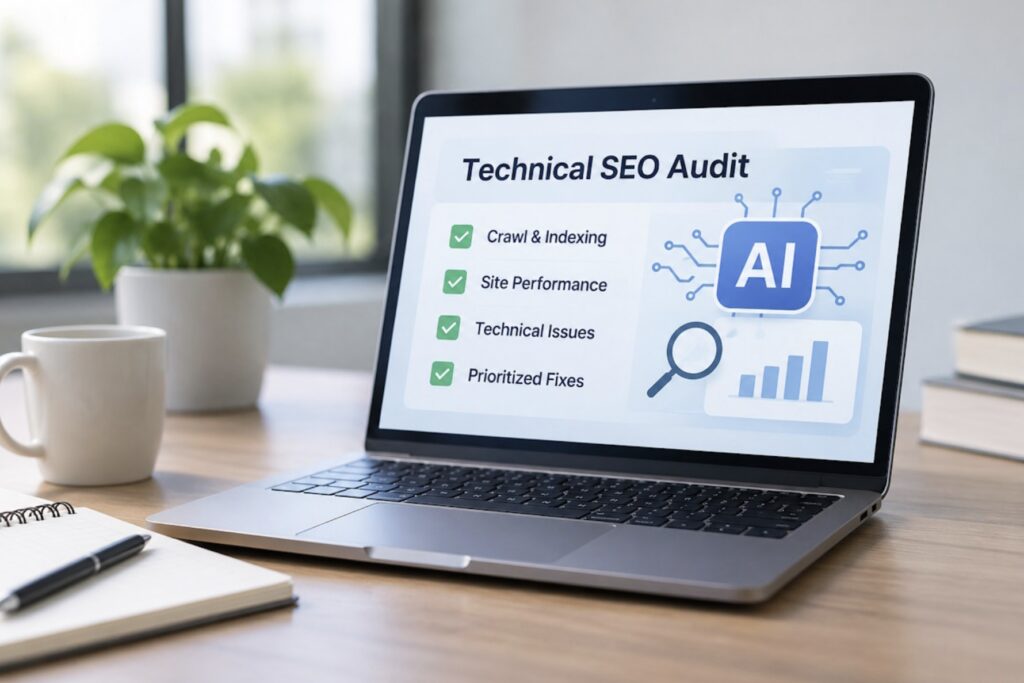
Technical SEO audits have always involved a fair amount of detective work. A website might look perfectly fine to visitors while search engines struggle with broken redirects, duplicate pages, missing metadata, or content that never gets indexed.
Finding these problems is only half the job. The harder part is often figuring out which issues actually affect search performance and which ones can wait.
That’s where artificial intelligence is starting to make a practical difference.
AI-assisted tools can examine large audit datasets, group related errors, identify unusual patterns, and help SEO teams investigate problems that might otherwise take hours to sort through manually. They can also explain technical findings in language that website owners and developers can understand.
But does that mean AI can handle an entire technical SEO audit on its own? Not quite. The real value comes from combining AI-assisted analysis with reliable crawl data, search performance metrics, and human judgment.
Here’s how that approach works and where it can make the biggest difference.
Why Traditional Technical SEO Audits Take So Much Time
A typical technical SEO audit involves examining several parts of a website, including crawlability, indexability, site architecture, internal linking, structured data, and page performance.
Tools such as Screaming Frog, Google Search Console, and Sitebulb can collect much of this information. The challenge comes when those tools produce hundreds or thousands of findings.
Consider a WordPress website with 5,000 URLs. A crawl might uncover:
- 300 pages with missing meta descriptions
- 120 URLs returning redirect responses
- 80 pages with duplicate title tags
- 45 pages with broken internal links
- Several important pages blocked from indexing
Not every finding deserves the same attention. Missing metadata on a low-value archive page may matter far less than an accidental noindex directive on a service page that generates leads.
Traditional auditing requires someone to review these findings, understand their context, and determine what needs fixing first.
AI can help with that analysis, provided the underlying information is accurate.
1. AI Helps Identify Patterns Across Large Crawl Reports
One of the more useful applications of AI in technical SEO is analyzing crawl exports.
Instead of reviewing thousands of spreadsheet rows individually, SEO specialists can use AI-assisted analysis to group similar problems and investigate relationships between them.
Imagine a website audit showing hundreds of duplicate title tags. At first glance, it might look like a content problem.
After grouping the affected URLs, the team discovers that most duplicates come from paginated category archives created by a WordPress theme.
That changes the investigation. Rather than rewriting hundreds of titles, the team can examine how the theme generates archive pages and whether those pages should be indexed.
AI can help identify patterns involving URL structures, page templates, metadata, and internal links. It can also generate scripts or spreadsheet formulas for further investigation.
The important distinction is that AI is interpreting the crawl report, not independently proving that every flagged issue is harmful.
Practical tip: Export crawl data into a structured format with URL, status code, indexability, canonical URL, title, and template information. Ask the AI tool to group issues by shared characteristics and explain which findings need manual verification.
2. Indexing Problems Become Easier to Investigate
Indexing problems can be frustrating because a page may be accessible to visitors without appearing in Google Search.
There are several possible explanations. A page might contain a noindex directive, point to another canonical URL, be blocked from crawling, or simply not have been selected for indexing.
AI can assist by comparing URL-level information from different sources and highlighting conflicting signals.
For example, suppose a website has 200 product pages that are absent from Google’s index. A crawl shows that the pages return HTTP 200 responses, but several contain canonical tags pointing toward broader category pages.
An AI-assisted review could group those URLs and identify the canonical pattern as something worth investigating.
The SEO specialist would still need to confirm whether the canonical tags are intentional and review Google’s indexing information before recommending changes.
This matters because not every excluded page represents an error. Duplicate pages, filtered URLs, and certain archive pages may be intentionally kept out of search results.
A useful audit should distinguish between pages that need indexing and pages that do not.
3. AI Makes Technical SEO Prioritization More Practical
A long list of SEO errors can make website owners feel that everything needs immediate attention.
In reality, technical fixes should be prioritized according to their likely impact, the importance of affected pages, and the effort required.
AI can help organize audit findings around those factors.
For instance, consider three issues discovered during a website audit:
| Technical issue | Potential impact | Suggested priority |
|---|---|---|
| Important service pages accidentally set to noindex | High | Urgent |
| Broken internal links across major navigation pages | Medium to high | High |
| Missing meta descriptions on old archive pages | Usually lower | Review later |
These are illustrative priorities, not universal rules. The right decision depends on the website’s traffic, business goals, and technical setup.
A missing meta description does not automatically prevent a page from ranking. A broken internal link may be more serious when it affects a page that is difficult for crawlers to discover.
AI can help create an initial priority list, but an experienced SEO professional should validate the reasoning before work begins.
Hog the Web’s guide to website traffic drops and their common causes also illustrates why diagnosing the underlying problem matters more than reacting to individual warning messages.
4. Website Performance Audits Gain More Context
Page speed has been part of technical SEO discussions for years, but performance reports can be difficult to interpret.
A PageSpeed Insights report may identify render-blocking resources, unused JavaScript, oversized images, and layout instability. Knowing which changes will actually improve the visitor experience requires further investigation.
AI can help translate performance findings into possible technical actions.
For example, if several WordPress pages show poor Largest Contentful Paint results, an AI-assisted review might suggest investigating oversized hero images, slow server responses, or delayed resource loading.
A developer can then use Chrome DevTools, Lighthouse, and real-user performance data to determine the actual bottleneck.
AI can also help compare reports from different page templates. If product pages perform poorly while blog posts remain fast, the investigation can focus on resources loaded specifically by the product template.
It’s useful to distinguish between laboratory measurements and real-user data. A single Lighthouse test does not represent every visitor’s experience.
For teams managing websites with recurring technical issues, establishing web performance budgets can help SEO specialists and developers agree on measurable performance targets and prevent regressions during future releases.
For a closer look at performance metrics, Google has a guide to Core Web Vitals covering loading speed, responsiveness, and visual stability.
5. AI Can Support Better Collaboration Between SEO Teams and Developers
Technical SEO recommendations often require changes to website code, templates, server settings, or content management systems.
An SEO specialist might identify incorrect canonical tags, but a developer may need to trace the problem to a theme template, plugin, or rendering process.
AI can help translate audit findings into clearer technical tasks.
Instead of sending a developer a spreadsheet containing 150 affected URLs, an SEO specialist can prepare a ticket explaining the shared issue, expected behavior, affected templates, and acceptance criteria.
For example:
Issue: Product pages contain canonical tags pointing to their parent category.
Expected behavior: Each eligible, distinct product page should reference its preferred canonical URL.
Validation: Check representative product URLs, inspect the rendered HTML, and confirm that the intended canonical signals appear after deployment.
This gives the developer a clearer starting point.
The key is ensuring that SEO recommendations are translated into changes that can be tested, reviewed, and maintained.
AI can help prepare those instructions, but developers remain responsible for evaluating code changes and confirming that they work as intended.
6. AI-Assisted Audits Can Detect Changes Between Website Versions
Technical SEO problems often appear after a redesign, plugin update, platform migration, or major content change.
A website that previously performed well might suddenly experience indexing problems because an important template was modified.
Comparing crawl data from before and after a deployment can reveal what changed.
AI-assisted analysis can help identify patterns such as:
- Previously accessible URLs now returning 404 errors
- Important pages receiving new noindex directives
- Internal links disappearing from navigation
- Canonical tags changing across an entire template
- New redirect chains introduced during migration
For example, imagine a WordPress redesign where service pages retain their original URLs but lose several internal links from the homepage and navigation menus.
An AI-assisted comparison could highlight the reduction in internal links and identify which page groups were affected.
That finding would give the SEO team a reason to investigate whether important pages became harder to discover.
For larger websites, this type of comparison is particularly useful because manually checking every changed URL is rarely practical.
Still, the comparison needs consistent crawl settings. Otherwise, differences in crawl configuration could be mistaken for website changes.
7. AI Helps Turn Audit Findings Into Actionable Reports
Technical SEO reports often contain more information than business owners need.
A detailed audit might include thousands of URLs, technical warnings, screenshots, and performance measurements. While that information is useful for specialists, decision-makers usually want to know what is wrong, why it matters, and what should happen next.
AI can help produce different report views from the same verified dataset.
A developer-focused report might contain affected URLs, reproduction steps, technical requirements, and testing instructions.
A business-focused report could explain which important pages are affected, what the likely consequences are, and how the proposed work should be prioritized.
For example, instead of reporting that 35 URLs contain incorrect canonical tags, the report could explain that several important product pages are sending signals suggesting another URL should be treated as the preferred version.
That explanation is more useful than an isolated error count.
Of course, reports should not claim that fixing a particular issue will guarantee a ranking increase. Search performance depends on many factors, and technical corrections do not always produce immediate traffic changes.
Where AI Still Falls Short in Technical SEO
AI can be helpful, but it has limitations that website owners should understand.
It can misinterpret technical data. An AI model might treat intentionally excluded URLs as indexing errors or recommend changes without understanding the site’s architecture.
It cannot reliably establish search performance impact from a crawl alone. A crawl can identify technical conditions, but understanding traffic loss requires additional evidence from Search Console, analytics, and website history.
It may suggest risky fixes. Incorrect changes to robots.txt, canonical tags, redirects, or structured data can create new problems.
It does not replace real-world testing. A suggested code change should be tested in a suitable environment before being released to a live website.
There are privacy considerations, too. Website audit exports may contain confidential URLs, customer-related information, or details about internal systems. Teams should review what data they share with third-party AI services.
The safest approach is to treat AI-generated findings as hypotheses that need verification rather than instructions that should be followed automatically.
A Practical AI-Assisted Technical SEO Audit Workflow
For teams looking to introduce AI into their audit process, a structured workflow is a good starting point.
- Step 1: Collect reliable website data. Run a technical crawl and gather relevant information from Google Search Console, analytics, and performance testing tools.
- Step 2: Identify the pages that matter. Separate important commercial pages, frequently visited content, and other valuable URLs from low-priority or intentionally excluded pages.
- Step 3: Use AI to group related findings. Look for patterns involving templates, URL structures, status codes, indexing directives, and internal links.
- Step 4: Verify the findings. Inspect representative pages, review source code and rendered HTML, and compare recommendations with actual search performance data.
- Step 5: Prioritize fixes. Consider the likely impact, affected pages, development effort, and risks associated with each change.
- Step 6: Test changes before deployment. Confirm that redirects, canonical tags, indexing directives, and other technical elements behave as expected.
- Step 7: Monitor results. Recrawl the affected pages and review Search Console data after deployment. Some changes may take time to appear in search reporting.
This process keeps AI focused on analysis and support while leaving technical decisions with the people responsible for the website.
The Future of Technical SEO Audits Is Human-Led and AI-Assisted
Technical SEO audits are becoming more complex as websites depend on additional scripts, third-party services, JavaScript frameworks, and increasingly complicated content structures.
AI offers a useful way to manage some of that complexity.
It can help teams identify patterns in crawl data, investigate indexing issues, compare website versions, and communicate technical findings more clearly.
But the most useful audit is not necessarily the one that finds the greatest number of errors. It’s the one that identifies the problems worth fixing and provides enough evidence to make the right decisions.
For website owners, that means AI should support a reliable technical SEO process rather than replace it.
The tools may change, but the goal remains familiar: make websites easier for search engines to access, understand, and navigate while providing a better experience for the people who use them.