Does SEO Help AEO? What Our Google AI Study Shows
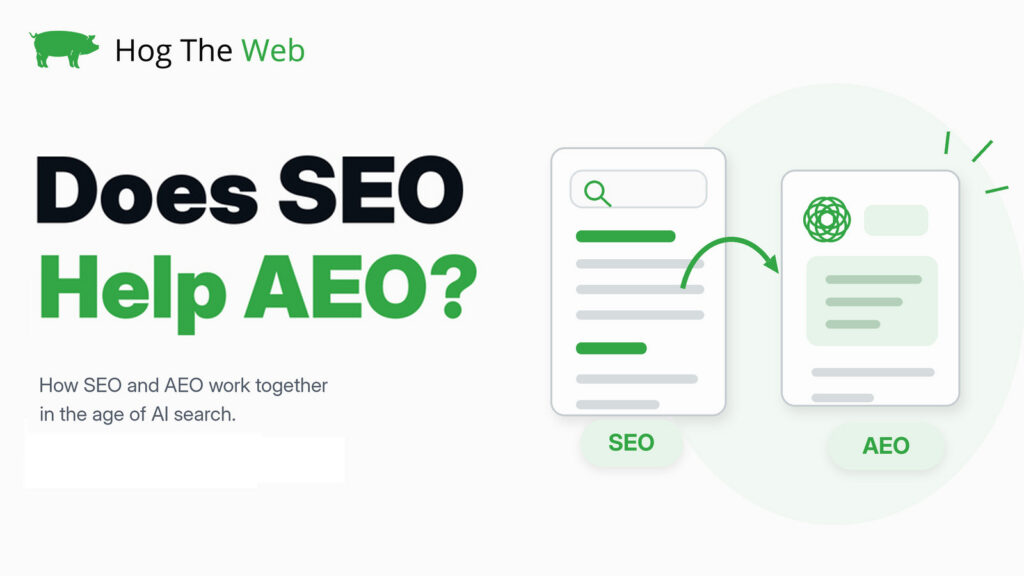
Quick answer: Yes. Traditional SEO still appears to matter quite a bit for AEO and Google AI search. In our recent analysis of nearly 366,000 Google Generative AI impressions, every page with meaningful traditional Google Search visibility also appeared in Google’s AI reporting.
But there was a wrinkle.
Pages with very similar rankings and traditional Search exposure could still receive wildly different amounts of visibility in AI Overviews and AI Mode. In a few cases, one page received four or five times the AI exposure of another page with a surprisingly similar SEO footprint.
That’s one of the more interesting findings from our new Google AI Search Visibility Study.
And for businesses wondering whether they should keep investing in SEO or switch their attention to AEO, GEO and AI search optimization, the data gives us a useful answer.
Is SEO Important for AEO and AI Search?
Yes, especially when we’re talking about Google’s AI Overviews and AI Mode.
AEO, or Answer Engine Optimization, is the practice of improving how well your business and content can be found, understood and surfaced in answer-driven search experiences.
That includes traditional search features, AI-generated answers and increasingly conversational search interfaces.
Google’s own documentation says its generative search experiences still rely heavily on its existing Search systems. AI Mode can perform several related searches behind the scenes, a process Google calls query fan-out, and then retrieve useful information from Google’s Search index.
Google also says the usual SEO fundamentals still apply to AI Overviews and AI Mode. There isn’t a separate technical checklist you have to unlock before Google can use your content.
Google’s current AI Search guidance makes that point pretty clearly.
Our data lines up with that general picture.
What We Actually Studied
We analyzed first-party Google Search Console data from a large, established health-information website that has access to Google’s newer Generative AI Performance report.
The study covered 99 days of data and included:
- 365,994 property-level Generative AI impressions from AI Overviews and AI Mode
- 1.5 million total Google Search impressions during the same period
- 155 normalized URLs appearing in the traditional Search dataset
- 136 URLs with reported Generative AI visibility
- Page-level comparisons of Search impressions, clicks, rankings and AI exposure
The full study goes into the methodology, aggregation differences, statistical limitations and several strange CTR patterns we found along the way.
If that’s your thing, you can read the complete Google AI Search Visibility Study here.
For everyone else, these are the findings that matter most.
1. Strong Organic Pages Usually Showed Up in Google AI Search Too
We found 155 URLs with traditional Google Search visibility.
Of those, 136 also had impressions in Google’s Generative AI report.
The 19 that didn’t were tiny pages. Mostly archives, pagination, testimonials and similar URLs with very little Google visibility to begin with.
The highest-visibility traditional Search page with no reported AI impressions had only 366 Search impressions across the entire 99-day study period.
More importantly:
Every page with at least 1,000 traditional Google Search impressions also appeared in Google’s Generative AI report.
There were 59 of those pages.
That doesn’t prove good SEO automatically earns AI Overview visibility. This was one website, in one industry, and Google’s reporting still has some important limitations.
But we didn’t find a meaningful organic page that was somehow invisible to Google’s AI systems.
For businesses asking whether traditional SEO still matters for AI search, that’s encouraging.
2. Most AI Visibility Came From a Surprisingly Small Number of Pages
This was probably the clearest finding in the whole study.
The website had 136 pages with reported Google AI impressions.
Just 14 of those pages generated approximately 81% of all page-level AI impressions.
The top 23 accounted for more than 90%.
Even after removing the unusually strong homepage from the calculation, AI visibility remained heavily concentrated among a relatively small group of content assets.
There is an obvious SEO lesson here.
You probably don’t need to rush through your entire website adding an “AI optimized” paragraph to every page.
Start with the pages that already matter.
Look at the content attracting meaningful impressions, backlinks, searches, leads and expertise signals. Understand why those pages have value before creating another 100 articles because somebody said AI search needs more content.
Google’s own AI-search guidance has moved in a similar direction. It repeatedly encourages unique, useful information rather than large volumes of commodity content.
3. Similar SEO Performance Didn’t Always Mean Similar AI Visibility
This is where things get much more interesting.
Two articles in our dataset had almost identical Google Search exposure:
- One received 69,872 traditional Search impressions.
- The other received exactly 70,000.
Their average Google positions were reasonably close too.
Yet the first page accumulated 23,275 Google AI impressions, while the other received only 8,696.
That’s roughly a 2.7X difference.
Another pair had 11,339 versus 11,192 traditional Search impressions, but their AI visibility differed by about 4.4X.
We even found two commercially oriented pages with similar Search exposure and virtually identical average positions where AI impressions differed by nearly 5X.
So traditional SEO performance clearly doesn’t tell us everything about AI visibility.
Why Would Two Similar-Ranking Pages Perform So Differently in AI Search?
We don’t know yet.
And that answer is important.
It would be easy to look at the higher-AI page and start crediting its headings, schema, author bio, paragraph length or some new GEO tactic.
The simpler explanation may be the searches themselves.
Suppose one article ranks primarily for questions that regularly trigger an AI Overview. Another article gets the same number of Google impressions from searches where AI Overviews rarely appear.
The second article could be every bit as good from an SEO perspective and still produce far fewer AI impressions.
Google currently doesn’t provide query-level data inside its Generative AI Performance report, so we can’t properly control for that yet.
This is one reason we think AI search visibility analysis needs a little restraint. An “AI underperforming page” isn’t automatically a bad page.
Sometimes you need to look deeper before touching something that’s already working.
SEO vs. AEO: What’s the Difference Then?
The distinction is getting a little fuzzy, particularly inside Google.
| SEO | AEO |
|---|---|
| Helps pages get crawled, indexed and ranked in search | Looks at how content and entities surface in answer-driven experiences |
| Tracks rankings, impressions, clicks and conversions | Adds AI visibility, citations, mentions and answer-engine exposure |
| Builds topical relevance and website authority | Examines whether answer systems understand and select those assets |
| Improves technical accessibility and page quality | Studies how strong pages perform differently inside AI-driven results |
| Targets traditional Google search demand | Also considers conversational and multi-step search behavior |
For Google specifically, we see AEO as an extension of a solid SEO strategy rather than a reason to rebuild your marketing from scratch.
Other AI platforms can work differently. ChatGPT, Perplexity and Gemini don’t all use the same retrieval systems or sources in exactly the same way.
That’s why we still think AEO is worth paying attention to.
But if your website isn’t technically sound, doesn’t rank for relevant subjects and doesn’t contain much worth retrieving, changing your heading structure for AI probably isn’t going to rescue it.
Does SEO Help With Google AI Overviews?
Our study suggests the answer is yes, with an important qualification.
Traditional organic visibility appears to give a page many more opportunities to be surfaced within Google’s generative search experiences.
Google itself says AI Overviews and AI Mode use its existing Search infrastructure and ranking systems to retrieve supporting information.
But ranking well doesn’t guarantee an equivalent amount of AI Overview exposure.
One page may rank across queries where AI answers are common. Another may have equally strong SEO visibility in search results where Google rarely generates an AI response.
And even when both pages are eligible, Google’s generative systems may find one more useful for a particular answer.
So we’d avoid thinking of AI Overview SEO as a separate ranking formula you can game.
What Should Businesses Actually Do?
You don’t need to rebuild your entire content strategy because AI Overviews exist.
There are, however, a few things worth doing now.
Keep the SEO foundation healthy
Make sure your useful pages can be crawled, indexed and understood. Keep improving internal links, content quality, site structure and technical performance. Those fundamentals still feed the systems Google uses for AI search.
Measure AI visibility alongside rankings
If your Search Console property has Google’s Generative AI report, start watching it. For other AI platforms, you’ll need different methods. We’ve also put together a guide to tracking AI traffic and search visibility.
Pay attention to your existing winners
Find pages that already have meaningful organic visibility and see how their AI exposure compares. A weird outlier can give you something useful to investigate.
Add things worth retrieving
Original data, firsthand experience, screenshots, expert commentary, case studies and specific examples give a page more substance than another generic summary of information that’s already everywhere.
Be skeptical of AI-only SEO tricks
Google currently says you don’t need special AI schema, an llms.txt file, artificial content chunking or hundreds of pages for slightly different prompt variations in order to appear in AI Overviews or AI Mode.
There are good reasons to experiment with AEO. Just make sure the experiment is solving an actual problem.
So, Is SEO Still Important for AI Search?
For Google, we’d say very much so.
Our study found that pages with meaningful traditional visibility were also showing up in Google’s AI-search reporting. The strongest organic assets tended to be strong AI-visibility assets as well.
At the same time, the variation between otherwise similar pages shows why SEO data alone isn’t enough anymore.
That’s where AEO becomes useful.
You can keep doing the work that makes a website valuable in Search, while adding another layer of measurement around AI Overviews, AI Mode and other answer engines.
There is still a lot we don’t know. Google’s AI reporting is new, query data isn’t currently available, and this first study covers one large website rather than the entire web.
But we finally have better data to work with than somebody posting a screenshot of ChatGPT and declaring SEO dead again.
Want the numbers, charts and methodology? Read the full Hog the Web Google AI Search Visibility Study.
Quick Questions About SEO and AEO
Does SEO help AEO?
Yes. For Google, many of the same things that help SEO also support visibility in AI Overviews and AI Mode, including crawlability, useful content, topical relevance and authority. AEO adds another layer of analysis around how that information appears in answer-driven search.
Is SEO important for AI search?
SEO remains especially important for Google’s AI search experiences because Google says they rely on its existing Search index and core ranking systems. Other AI platforms may rely on different retrieval methods and outside sources, so the exact relationship varies by platform.
What’s the difference between SEO and AEO?
SEO focuses broadly on search visibility, rankings, traffic and conversions. AEO focuses more specifically on whether content and brands are understood and surfaced inside direct answers, AI-generated responses and conversational search experiences.
Does ranking higher in Google guarantee AI Overview visibility?
No. Our data found pages with similar rankings and Search impressions that received very different levels of Google AI exposure. Query type and whether a search triggers an AI feature may explain part of that difference.
Do I need special schema for AEO?
Google currently says there is no special AI schema required for AI Overviews or AI Mode. Normal structured data can still help Google understand pages and qualify them for supported Search features, so accurate schema remains useful. It just isn’t a secret AI-ranking switch.
Need help connecting traditional SEO with AI-search visibility? Hog the Web provides hands-on WordPress SEO and AI-search optimization services, including technical SEO, content strategy, Search Console analysis and AI visibility measurement.