Website Ranks on Google but Gets No Leads? 7 Reasons Why

Your website ranks on Google. Organic traffic is coming in. Yet the phone is quiet, form submissions are scarce, and rankings don’t seem to translate into revenue.
That does not necessarily mean SEO has failed.
At Hog the Web, we have spent more than 10 years helping 300+ businesses with WordPress websites, SEO, development, and ongoing support. One pattern we repeatedly see is that rankings can expose an existing weakness elsewhere in the customer journey.
Here are seven places that journey commonly breaks.
Are You Ranking For Searches That Could Realistically Produce Customers?
If your highest-traffic keywords have weak buying intent, more organic traffic may produce very little business.
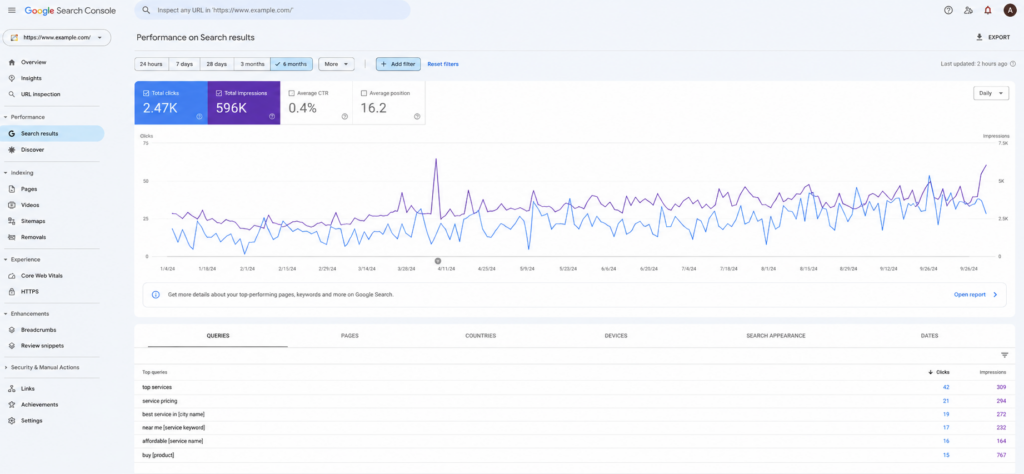
Google Search Console lets you view the exact queries generating impressions and clicks. Google specifically recommends examining which queries bring traffic and which pages Google shows for those searches.
Consider a roofing company ranking for:
- “How long do roof shingles last?”
- “Signs of roof damage”
- “Roof replacement company near me”
All three are relevant. Only the third strongly suggests someone is currently looking for a provider.
HTW Observation
Do not start an SEO review by asking, “How much traffic did we get?” Start with, “Which landing pages received traffic from searches connected to an actual service we sell?”
Does A Page-One Ranking Actually Generate Enough Clicks?
Not necessarily. “Page one” covers positions with dramatically different click potential.
A Backlinko analysis of roughly four million Google results found the #1 organic result averaged a 27.6% click-through rate (CTR), while the top three positions collectively received 54.4% of clicks. The #1 result was about 10 times more likely to receive a click than the #10 result.
Google itself advises focusing on trends in impressions and clicks, rather than treating average position as the primary success metric.
HTW Observation
A report saying “18 keywords rank on page one” can sound impressive while hiding the more important question: How many qualified searchers actually clicked?
Could Your Search Result Itself Be Losing The Click?
Yes. A ranking earns visibility, but the title and snippet still have to persuade someone that your result is worth opening.
Google calls the title link one of the primary pieces of information people use when deciding which search result to click. It recommends titles that are descriptive, concise, unique, and relevant to the page.
Google also explains that search snippets may come from page content or, when appropriate, the meta description.
HTW Observation
If a URL has thousands of impressions but weak CTR, rewriting the title around the searcher’s problem may deserve attention before creating another blog post.
Does The Landing Page Immediately Prove You Can Solve The Visitor’s Problem?
If the page is generic, even perfectly qualified SEO traffic can fail to convert.
Visitors need quick answers to three questions:
- Do you solve my specific problem?
- Why should I trust you?
- What should I do next?
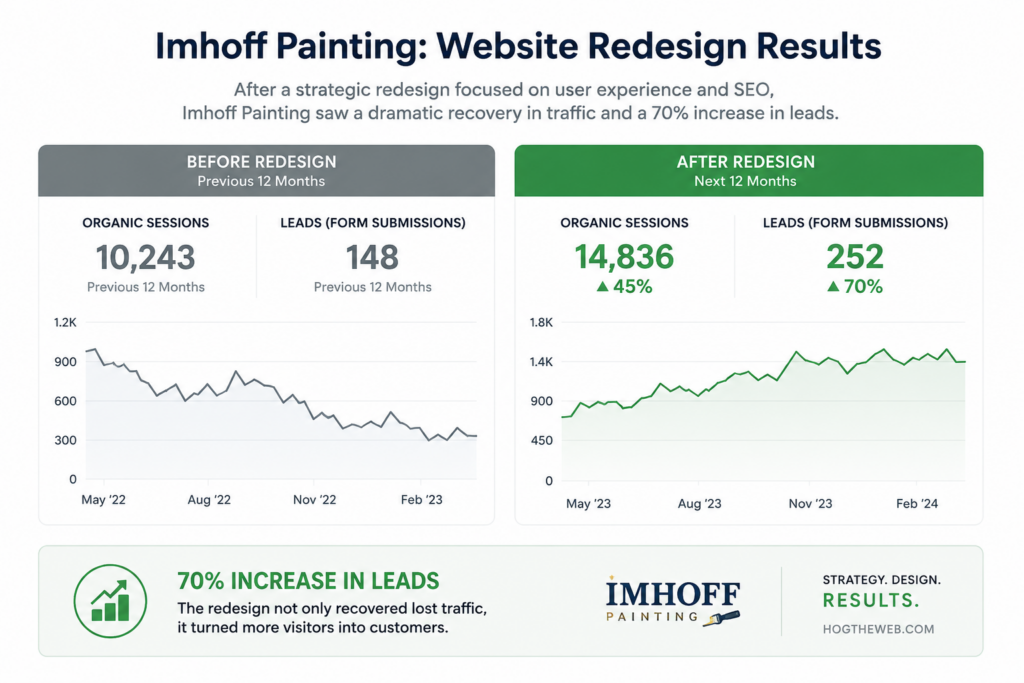
This became especially clear in Hog the Web’s work with Imhoff Fine Residential Painting.
Their original website had built a substantial organic footprint, including hundreds of articles and numerous service pages. It was receiving roughly 300 organic visits per day, but the service pages lacked strong portfolio proof, compelling testimonials, and clear calls to action.
During the redesign, Hog the Web preserved the search assets already producing visibility while improving those conversion elements.
The result? Leads increased 70% compared with the original website.
That is why ranking and conversion optimization should not be treated as separate worlds.
Is Website Speed Creating Friction After Someone Clicks?
It can. Performance problems can undermine an otherwise successful landing page.
Google’s Core Web Vitals measure real-world loading, responsiveness, and visual stability. Its recommended thresholds include an LCP of 2.5 seconds or less, INP below 200 milliseconds, and CLS below 0.1.
But the useful question is not simply, “Is my WordPress site fast?”
It is: Are performance problems occurring on the pages receiving valuable organic traffic?
HTW Observation
Prioritize fixing a slow service page that already attracts prospective customers before obsessing over a low-traffic page simply because its performance score looks worse.
Are You Measuring Rankings Instead Of Measuring The Path To A Lead?
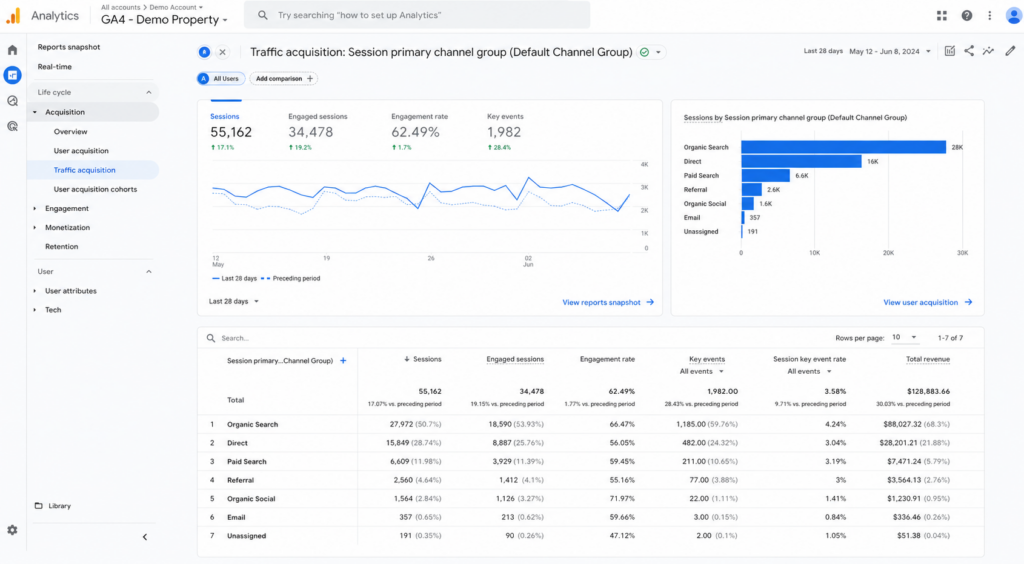
Search Console tells you how visitors reached the website; Analytics helps show what happened afterward. You need both.
Google’s Search Console integration with Google Analytics connects organic queries and landing pages with on-site behavior and key events.
For every important organic landing page, compare:
Query → Impression → Click → Landing Page → Key Action → Lead
That simple chain often reveals exactly where performance breaks.
How Should You Diagnose A Website That Ranks But Produces Few Leads?
Use the HTW Search-to-Lead Audit: four dimensions that identify where search visibility stops becoming business.
1. Intent Match
Are you attracting searches connected to services people can actually buy?
2. Click Appeal
When Google shows your page, do the title and search snippet earn the click?
3. Trust & Offer
Does the landing page clearly demonstrate what you do, who it is for, and why someone should choose you?
4. Conversion Path
Is the next action obvious, low-friction, and measurable?
Viewed through this framework, the Imhoff case is revealing. Intent Match already existed through established service content. Trust & Offer needed improvement through testimonials and portfolio proof. Conversion Path improved through clearer calls to action. Click Appeal is the dimension we would validate separately using Search Console CTR data rather than assume.
That is a more useful diagnosis than simply saying, “We need more SEO.”
Google increasingly emphasizes useful, original content that adds genuine value rather than reproducing information already available elsewhere, including in its AI-powered Search experiences.
Turn Google Visibility Into Business
If your website ranks on Google but gets no leads, chasing more keywords may just send more traffic down the same broken path.
Hog the Web combines WordPress SEO, web design and development, ongoing website support, and conversion-focused thinking to identify what is already working and fix what happens between the Google search and the inquiry.
The objective is not rankings for their own sake.
It is getting the right person to the right page, giving them enough reason to trust you, and making the next step easy.
Talk to Hog the Web about your website